


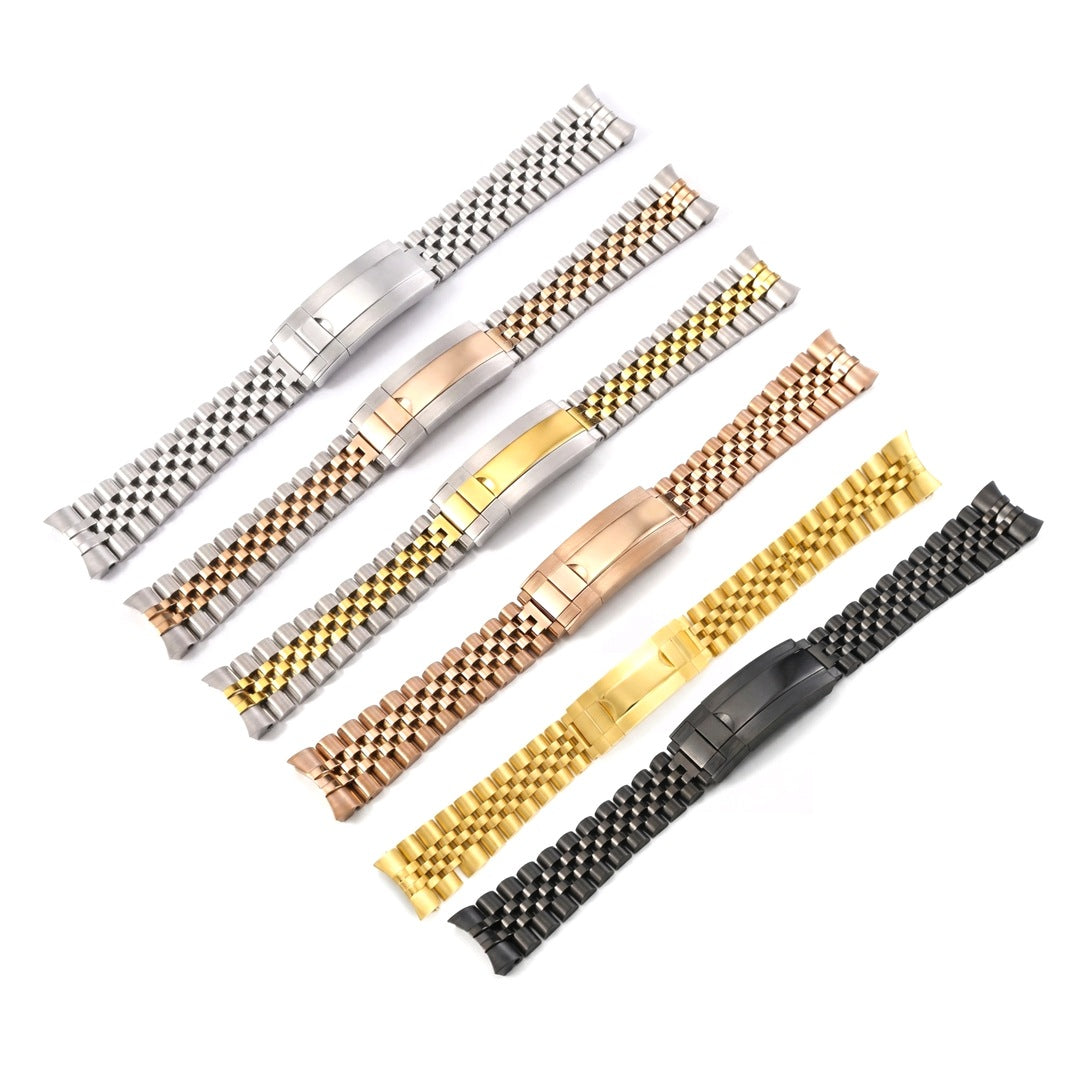
Start with an Oyster-style bracelet for a simpler three-link look, or a Jubilee-style bracelet for a more detailed five-link appearance. Comfort depends on the actual bracelet, clasp and adjustment, so neither name alone establishes the better fit.
In this guide, Oyster-style and Jubilee-style describe bracelet designs. Watcheray’s accessories are aftermarket products, not claims of genuine Rolex manufacture or affiliation.
What is the visual difference?
An Oyster-style design has three broad sections across each row. Its larger visual surfaces can work well with a clean dial or a more sporty case. A Jubilee-style design uses five sections across the row, with narrower centre links creating a more intricate pattern.
Finishing makes a difference too. A bracelet with polished centre sections will reflect light differently from one with a predominantly brushed finish. Compare the photographs of the exact colour and finish you intend to order.
| Detail | Oyster-style | Jubilee-style |
|---|---|---|
| Typical pattern | Three sections across a row | Five sections across a row |
| Styling starting point | Simpler, broader visual surfaces | A finer, more detailed pattern |
| Comfort check | Try the articulation and clasp position | Try the articulation and clasp position |
| Replacement check | Lug width, end links and spring bars | Lug width, end links and spring bars |
Which bracelet is more comfortable?
A well-adjusted bracelet should let the watch sit securely without a tight pressure point. The important details include how the links move around your wrist, whether the clasp is centred comfortably and whether the adjustment range suits you.
A five-link design can feel more flexible in some executions, but link count is not a comfort guarantee. A three-link bracelet with the right length and articulation may suit your wrist better than a poorly adjusted alternative. Check the construction of the specific accessory.
Check compatibility before buying
The listed Watcheray Oyster-style bracelet and Jubilee-style bracelet have a 20mm lug-width specification. That is the gap where the bracelet attaches to the case; it is not the watch diameter.
Matching 20mm width is necessary, but it does not guarantee a fit. A curved end link also needs to match the case shape and spring-bar position. Integrated-bracelet cases may use a different attachment altogether.
- Confirm the exact watch model and lug width.
- Check whether its attachment uses curved end links, straight ends or an integrated design.
- Confirm the spring-bar and end-link fit with the seller.
- Review bracelet length, removable links and clasp adjustment before ordering.
If you are unsure, send us the watch link and a clear photo of its attachment. Do this before ordering a replacement rather than assuming two watches in the same family use identical bracelets.
Pairing a bracelet with your watch
For a dress-oriented combination, compare the Jubilee-style look of Seikojust | Olive Green. For a different case style using a Jubilee-style bracelet, see GMTeiko | Bruce Wayne. These are complete-watch examples, not compatibility promises for every replacement accessory.
If you prefer to choose the combination from the start, explore the options shown in the Seikojust configurator. The straps and bracelets collection also includes 20mm FKM rubber straps for another look; attachment compatibility still needs checking.
Common questions
Does a 39mm watch need a 39mm bracelet?
No. Case diameter and lug width measure different things. Use the lug-width and attachment specification.
Can I move the same bracelet between two 20mm watches?
Possibly, but width alone is insufficient. End-link shape and spring-bar position must match as well.
Should I choose the case size or the bracelet first?
Check both together. Our 36mm vs 39mm guide explains how the case and the first bracelet links affect the overall fit.


Leave a comment
This site is protected by hCaptcha and the hCaptcha Privacy Policy and Terms of Service apply.